

NAM-1975
Feb 12, 2011NAM-1975 is a 1990 war-themed action shooting game released by SNK. It was the first game released for Neo Geo arcade and home platform, and the only title to not feature the Neo Geo logo in its attract mode.
"The roar of the helicopters overhead snaps us back into reality. We will never forget the nightmare of that summer..." these were the phrases that started the story of Silver & Brown (the names used to describe the two available players).
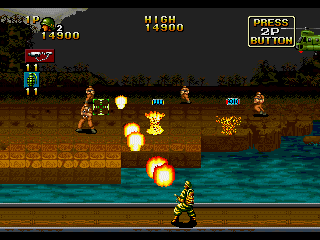
The game is set in a very fictional account of the final months of the Vietnam War. The story begins with the two soldiers entering the war to rescue Dr. R. Muckly, an ex-scientist of the American Army, who has been kidnapped by Northside Terrorists. Nancy Muckly, Dr. Muckly's daughter has also been kidnapped and is presumed imprisoned in the NAM interior.
However, as the game progresses, the armies learn that Dr. R. Muckly is a madman who is building a gigantic laser cannon to take over the world himself (the final boss battle was infamous for disallowing continues, except by modifying the DIP switch).
There are many references to many famous Vietnam War films in the game, such as Apocalypse Now and Full Metal Jacket: the attract sequence showing one of the characters firing off an M60 machine gun is clearly ported from the shot of Animal Mother firing on the VC sniper in the latter film.
Neo Turf Masters
Feb 7, 2011Neo Turf Masters (Big Tournament Golf in Japan) is a golf video game by Nazca for the Neo Geo, released in 1996. This is also one of the first two titles by Nazca, the other being the popular Metal Slug before being acquired by SNK.
The game was released as an arcade cartridge (MVS), a home cartridge (AES), as well as for the Neo Geo CD console. The Neo Geo version was later re-released as part of the SNK Arcade Classics Vol. 1 compilation for the PS2, Wii and PSP, as well as for the Wii Virtual Console.
The game is a fast paced, arcade-style golf game. Players choose from two game modes, stroke play for one or two players, and match play for only two players.
Competing on one of four fictional golf courses located in the United States, Japan, Australia and Germany, players choose from one of six players with different attributes:
* George Spinner, an American young hero
* Thomas Stewart, a British technician
* Frank Adams, an Australian veteran
* Robert Landolt, a German shot maker
* Fernand Almeida, A Brazilian power golfer
* Toyoshiege Takeno, A Japanese putt master

Neo Driftout
Feb 3, 2011Pull the joystick in a direction to steer and maneuver the car. Press the A button to accelerate. Press the B button to put on the brakes. The player has a choice of either a Mitsubishi Lancer, a Suburba Impreza or a Toyota Celica each with their own different levels of own Speed, Control and Body stats. To start off the player has to win the Practice Stage. In each racing stage, the player needs to get to the finish line in the shortest time possible.
If the clock hits zero, the player loses and the game is over unless they can continue. While driving, the time is hindered by barrels, puddle, slippery ice, cones and other obstacles in the player's path. Even other cars driving can be an obstacle. Also the player has to keep straight when driving up slopes, or the car will swurve and crash. The player can gain more time if they make it through checkpoints in between the starting and finishing points. The player can also take shortcuts. Before making a turn, the player will always get an immediate warning on the screen with a voice saying which direction the player ought to turn and certain warnings. There are a total of seven stages in the game: The Practice Stage, The European Stage, The African Stage, The Snow land Stage, The Southern Hemisphere Stage, The Scandinavian Stage and the Great Britain Stage.

NBA Jam
Dec 13, 2010NBA Jam, which featured 2-on-2 basketball, was one of the first real playable basketball arcade games, and was also one of the first sports games to feature NBA-licensed teams and players, and their real digitized likenesses.
A key feature of NBA Jam was the exaggerated nature of the play - players jumped many times above their own height, making slam dunks that defied both human capabilities and the laws of physics. There were no fouls, free throws, or violations except goaltending and 24 second violations. This meant the player was able to freely shove or elbow his opponent out of the way. Additionally, the game had an "on fire" feature, where if one player made three baskets in a row, he would become "on fire" and have unlimited turbo, no goaltending, and increased shooting ability, until the other team scored (or the player had scored four consecutive baskets while "on fire").
The game is filled with easter eggs, special features and players activated by initials or button/joystick combinations. For example, pressing A five times and right five times on any Sega Genesis controller would activate 'Super Clean Floors'. This feature would cause characters to fall if they ran too fast or changed direction too quickly. And players could enter special codes to unlock hidden players, ranging from US President Bill Clinton to Hugo the Charlotte Hornets mascot. Early versions of the sequel, NBA Jam Tournament Edition, allowed players to put in codes that allowed people to play as characters from Mortal Kombat, but the NBA, uneasy over the controversies surrounding Mortal Kombat's levels of violence, forced Midway to remove these characters in later updates.
How to play
execute Play xxx.bat
Coins Insert : 5 P1 start : 1 Game controller Up : arrow Up Down : arrow Down Left : arrow Left Right : arrow Right Button Button A : W Button B : E Button C : R Button D : T Button E : Y Button F : U

Marvel vs Capcom: Clash of Super Heroes
Dec 9, 2010While the gameplay was typical of the Marvel vs. Capcom series, Marvel vs. Capcom was distinguishable by two features: the ability to summon assist characters, and the Duo Team Attack.
Unlike the previous game in the series, the point character of a Marvel vs. Capcom team could not summon the offscreen partner for an assist attack; instead, an assist character was randomly selected before the match began. This character could be summoned a limited number of times in battle to attack the opponent in parallel. Codes could be used to force the system to select a certain assist character.
The Duo Team Attack allowed a player to control both characters on his or her team simultaneously for a brief period of time; the characters had unlimited use of their super moves during this time. Since some characters had hard-to-avoid super moves that did substantial damage if blocked, the Duo Team Attack led to tactics that were oriented around activating it before your opponent could. Since the PlayStation port only allowed one character to play a point, a Duo Team Attack would call the assist character repeatedly without cost during its duration.

Marvel Super Heroes vs Street Fighter
Dec 8, 2010The game uses the same tag-team format previously employed in X-Men vs. Street Fighter. In addition to all the features introduced, the player can now summon their partner to perform one of their special moves without changing their currently-controlled character.
Most of the Street Fighter characters from the previous game returned, with the exception of Cammy and Charlie, who are replaced by Dan and Sakura. However, all of the X-Men characters from the previous game, with the exception of Cyclops and Wolverine, are replaced with characters from Marvel Super Heroes, in addition to Omega Red.
Like in X-Men vs. Street Fighter, the single-player mode consists of matches against other tag-teams and a two-on-one fight against Apocalypse. However, the final fight that pits the player's default character against his partner is replaced with another two-on-one match, this time against a cyborg version of Akuma. The character who deals the finishing blow to Cyber-Akuma will have their ending played.
All of the backgrounds from X-Men vs. Street Fighter returning for this game are redone in palette swap fashion. All of the default characters come from previous fighting games by Capcom, unlike other games in the series which have all made new introductions.

Matrimelee
Dec 6, 2010The game uses a four button layout, two buttons for punches and two for kicks. Every character has their own stage, attacks and special moves. The special moves are performed via combinations of joystick movements and buttons. Transformations from the older titles did not make a comeback but some of the forms appear as their own character.
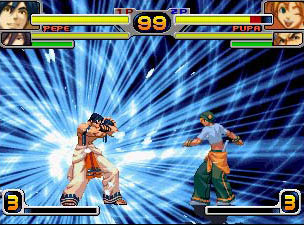
The Stress meter -the game's super meter- now could be filled up to three levels. Every character has a Stress Shot (1 bar), an Ippatsu Ougi (2 bars) and a powerful, hidden super attack called a Kinjite (3 bars). However, only a few of the Kinjite moves are known; information on the rest have not been released by Atlus or Noise Factory.
Players can also use the judge, Kuroko, as a shield or one-shot projectile.
Special Note
this game use WinKawaks as well,
but unmark the 'Hide Redundant Games' on File -> Load Game
and then it will showing up
Mortal Kombat III
Nov 25, 2010Mortal Kombat 3 builds further on the gameplay of the previous game. A "Run" button, accompanied by a "Run" meter, was introduced. This was primarily to address concern from fans who thought that the previous games gave too much of an advantage to the defending player. The Run meter is drained by running (the character cannot run backwards, only forwards) and by performing combos. "Chain combos", also known as pre-programmed combos (labeled "dial-a-combos") were also introduced. Chain combos are preprogrammed button presses that cannot be interrupted once one hit connects (e.g., one of Sonya's chain combos is HK-HK-HP-HP-LP-b+HP). Some chain combos end with an uppercut or other move that knocks the opponent into the air, so that more punishment can be dealt via a traditional juggle combo. To please players of various skill levels, a "Choose Your Destiny" screen appears in 1-player mode. This new feature allowed player-selectable difficulty.
For the first time, certain levels were interactive by allowing characters to be uppercutted through the ceiling where both characters would continue the battle in a different stage. This could alter the game's level cycle. Both normal uppercuts and uppercuts that are part of a ground combo would result in a level change. Kung Lao's "Whirl Wind Spin" move would also have the same effect. However, if the final hit of a round happens to be an uppercut (i.e., the character is defeated by an uppercut), there is no level change.
All of the different style of finishing moves featured in Mortal Kombat II (Fatalities, Babalities, and Friendships) return in MK3 but this time the announcer saying "Friendship! Friendship?!" was changed to "Friendship! Friendship?! Again?!". Additionally, the long rumored Animality, where the character transforms into an animal in order to kill their opponent, is featured for the first time. Another new addition is the Mercy, where the character can give their opponent a small sliver of life if they have won two rounds and are at the "Finish Him/Her" screen. It is necessary that a Mercy is performed for an Animality to occur. Finally, three new stage Fatalities can be performed in the Subway, the Bell Tower, and the Pit 3.
How to play
execute Play xxx.bat
Coins Insert : 5 P1 start : 1 Game controller Up : arrow Up Down : arrow Down Left : arrow Left Right : arrow Right Button Button A : W Button B : E Button C : R Button D : T Button E : Y Button F : U

Mortal Kombat II
Nov 20, 2010Following his failure to defeat to Liu Kang in the first Mortal Kombat game, the evil sorcerer Shang Tsung begs his master, Shao Kahn, to spare his life. He tells Shao Kahn that the invitation for Mortal Kombat cannot be turned down, and if they hold it in Outworld, the Earthrealm warriors must attend. Kahn agrees to this plan, and even restores Tsung's youth. He then extends the invitation to Raiden, who gathers his warriors and takes them into Outworld. The new tournament is much more dangerous, as Shao Kahn has the home field advantage, and an Outworld victory will allow him to subdue Earthrealm.
The gameplay of Mortal Kombat II is an extension of the previous game. Normal moves have been expanded: a crouching punch was added, and low and high kicks became differentiated be it crouching or standing up; the roundhouse kick was made more powerful and knocks opponents across the screen. Additionally returning characters gained new special moves and the game marked introduction of multiple Fatalities (post-match animations of the victorious characters executing their defeated foes), as well as additional, non-lethal finishing moves to the franchise. However, each character still shared generic attributes – speed, power, jump height and airtime – and although having different hitboxes, all normal moves were the same between each character. The game also plays slightly faster and more smoothly.
As with its predecessor, matches are divided into rounds, and the first player to win two rounds by fully depleting their opponent's life bar is the winner; at this point the losing player's character will become dazed and the winner is given the opportunity of using a finishing move. In addition to the Fatalities of its predecessor, MKII offers Babalities (turning the opponent into a crying baby), Friendships (a non-malicious interaction, such as dancing or giving a gift to the defeated opponent) and stage-specific Fatalities (the winner uppercutting his or her opponent into an abyss below, spikes above, or a pool of acid in the background). This game drops the point system from its predecessor, in favor of a consecutive win tally.
Both the theme and art style of Mortal Kombat II are slightly darker, although with a more vibrant color palette employed and a much richer color depth than in the previous game. MKII also strays from the strongly oriental theme of its predecessor, though it does retain the original motif in some aspects, as in some of the music. Finally, the nature of the game became less serious with the addition of trivial and "joke" alternative finishing moves.
How to play
execute Play xxx.bat
Coins Insert : 5 P1 start : 1 Game controller Up : arrow Up Down : arrow Down Left : arrow Left Right : arrow Right Button Button A : W Button B : E Button C : R Button D : T Button E : Y Button F : U

Neo BomberMan
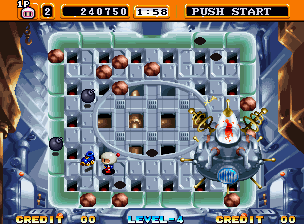
Oct 25, 2010Neo Bomberman is one of two Bomberman games developed by Hudson Soft to be released for the Neo Geo hardware, the other being Panic Bomber. Unlike Panic Bomber, a puzzle game, Neo Bomberman retains the traditional top-down gameplay.
Single-player
The gameplay consists of walking through maze-like areas filled with monsters with a goal of opening the gate leading to the next area. Playing as a bomberman, the player can lay bombs to destroy all of the monsters, which will subsequently open the gate. Destroying blocks in the maze may uncover useful items including remote control bombs, accelerators, and hearts.
Multiplayer
In Battle Mode, one to two players can face off against up to three AI players in one of ten arenas designed specifically for multiplayer play. Matches can be customized as battle royal matches or as team matches. Besides the regular items found in singleplayer mode, the glove (allowing Bomberman to pick up and toss bombs) and speed increases can be found in multiplayer.
Nightmare in the Dark
Oct 21, 2010First of all, I think any review of NitD must make a passing reference to Snow Bros., a fine arcade game created by Toaplan and released by Romstar (the same company that released some of SNK's early pre-Neo Geo games). The second best analogy would be Taito's Bubble Bobble, but Snow Bros is obviously a direct influence. If you know, or have ever played Snow Bros., I can quickly review NitD by saying its Snow Bros. with ghosts, zombies and other assorted monsters, and instead of snow you use magic fire, turning your enemies into rolling fireballs instead of rolling snowballs.

If you've never played Snow Bros. (you're missing out), the concept of that game and NitD is simple: you must clear the level (single frame) by attacking enemies with your regular shot, turning them into a large ball, and then lobbing them at other enemies to eliminate them. Touching enemies before you change them kills you. After a number of levels, you face a boss who must be killed by a combination of direct attacks and rolling smaller enemies into them. That's pretty much the gist of both Snow Bros. and NitD.
Magician Lord
Oct 19, 2010The player controls the wizard Elta, the last magician lord, on his quest to save his homeland from the evil wizard Gal Agiese. The evil wizard is seeking the god of destruction Az Atorse whom he plans to resurrect this using eight tomes of mystical power. As Elta, the player must battle through eight levels to find each of the tomes before he can reach Gal's fortress, and seal away the evil deity once again.
Elta has to jump, shoot and climb his way to the end of each level where he must beat a servant of Gal, along with one of Gal's sinister creations (boss), in order to progress to the final stage where he will fight Gal Agiese, and Az Atorse himself. The gameplay is typical to a standard action-platformer fitted for arcade machines and thus very challenging. Aside from the fantasy themes there's an added twist of transformations that make the Wizard more powerful and grants him new attacks. When he has not been transformed, Elta's primary form of attack is a weak but fast-moving energy projectile that he can shoot in four directions; left, right, up and (while jumping) down.

Metal Slug 3
Sep 24, 2010Metal Slug 3 is a run and gun video game for the Neo-Geo console/arcade platform created by SNK that was released in 2000 and is the sequel to Metal Slug 2. Being the last Metal Slug that SNK was working on until the bankruptcy, it was given a lot of features, enhancements and improvements.[citation needed] The music of the game was developed by Noise Factory.[1] The game was ported to the PlayStation 2 and Xbox. The game was also released for the Wii, PSP, and PS2 as part of the Metal Slug Anthology.
Story
The rebellion orchestrated by General Morden to bring about a new global regime is now ancient history, and order and peace has begun to return to the world. Morden, brought back into power, was attempting another coup d'état, but government forces got wind of the plot beforehand and pre-empted the impending assault.
Instrumental in squashing Morden's rebel forces, Marco and Tarma of the Peregrine Falcon Strike Force are ordered to lead the team after their earlier requests for resignation were denied. Although General Morden has been written off as "missing" by his followers, they have hidden themselves throughout the world, and Marco and Tarma's abilities and experience are seen as a necessity to destroy remaining rebel strongholds, one by one. Throughout the furious fighting against the holdouts, Marco and Tarma cannot help but suspect Morden's involvement in this new evil plan for world domination.
Meanwhile, the SPARROWS, a special strike force within the government intelligence agency, have come across a series of strange events running parallel to the Peregrine's pursuit of General Morden. From trivial abductions of livestock to the disappearance of government officials and the appearance of freakishly large creatures, numerous occurrences with nothing in common point to one grim possibility. General Morden is not the only menace to worry about. Eventually it is learned that the alien menace that appeared in Metal Slug 2/Metal Slug X have returned. After defeating what appears to be General Morden, it turns to really be an alien in disguise, while the real Morden was their prisoner (again). The aliens abduct the character the player uses, and another character takes his/her place. Once again, an ad-hoc alliance is formed to combat the external threat, with Rebel Army supplying a rocket ship that allows the player to break into the aliens' mothership. After a long battle throughout the ship's interior, mothership starts to collapse from all the damage. The player manages to escape, but is confronted by the aliens' leader, Rootmars, when falling through the Earth's atmosphere. Rootmars is defeated and is left for dead in the ocean.

Metal Slug 2 Super Vehicle-001/II
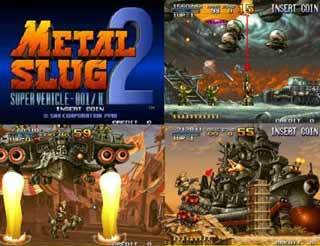
Sep 23, 2010Metal Slug 2 is a run and gun video game for the Neo-Geo console/arcade platform created by SNK. It was released in 1998 for the MVS arcade platform and is the sequel to the popular Metal Slug. It is the second title in the Metal Slug series. The game was later re-released in a slightly modified/remixed form as Metal Slug X. It was re-released for the Wii's Virtual Console in North America on December 1, 2008 at a cost of 900 Wii Points.
Story
General Morden, the antagonist from the first game is back once more with his army, bent on taking over the world. It is up to the Peregrine Falcon squad, who are now joined by two new characters: Eri Kasamoto and Fiolina Germi of the Sparrows Intelligence Unit, to save the day.
As the levels unfold, it turns out that Morden has allied with Martians to help facilitate his plans. In the final level of the game, the tables are turned when Morden comes under attack and is betrayed by his Martian allies and taken prisoner by them. An ad-hoc alliance is formed between the Peregrine Falcon squad and General Morden's army to combat the greater alien threat. After a long battle, they succeed in defeating the Martians' Mothership, driving them off the Earth. Morden seems to have fallen from the ship, strapped to a solid iron plate. While his soldiers celebrate, the plate loses its balance and crushes him.
Metal Slug Super Vehicle 001
Sep 22, 2010Metal Slug is a run and gun video game for the Neo-Geo console/arcade platform developed by Nazca Corporation and published by SNK. It was originally released in 1996 for the MVS arcade platform. The game is widely known for its sense of humor, fluid hand-drawn animation, and fast paced two-player action. It is the first title in the Metal Slug series.
Gameplay
The player has to constantly shoot at a continual stream of enemies in order to reach the end of a level. At the end of each level, the player might confront a boss who is often considerably larger than regular enemies and takes many shots to defeat. On the way through the level, the player finds weapons upgrades and "Metal Slug" tanks that can be used not only as weapons but also as added defense.
The protagonists can perform melee attacks by using a knife and/or kicking. The player does not die for simply coming into contact with most enemies. Correspondingly, many of the enemy troops have melee attacks. Much of the game's scenery is destructible. Sometimes this reveals extra items or powerups, most of the time it simply results in collateral damage.
During the course of a level, the player encounters POWs. If these are freed, the player can receive bonuses in the form of random items or weapons. The player receives a score bonus for freeing prisoners at the end of the level; at this point the game shows the name and rank of each POW freed. If the player dies before the end of the level, the tally of freed prisoners is restarted.
There are a total of six levels, with themes ranging from forests, garrisoned cities, snowy mountain valleys, canyons, and military bases.


